

Thursday, March 31, 2016
12 Ways to Support ELL Students in the Mainstream Classroom
This article includes 12 ways to support ESL students in the mainstream classroom but can easily be applied to my ELL students in South Burlington. Check it out!


Journal #9
Journal #9
Unfortunately, I was the only one in my group that was able to attend tutoring today, but it provided me with a fun challenge to see if I could tutor multiple students. Jeff and Doma were able to attend tutoring today, but Carol was unable to. It was nice to work with Doma again because I was able to connect on an emotional level during our initial tutoring session. Her only assignment was to take notes on an article. I tagged this journal entry under Learners Growth and Development because while Doma was taking notes, she was able to sum up the main ideas in her own words. When I first worked with her, she was only able to copy the words straight from the text when taking notes.However, I have seen a major improvement in her comprehension of texts.
It was my first time working with Jeff because he normally does not attend tutoring sessions. This is typical of ELL students because they are probably so mentally exhausted by the end of the school day that they just want to go home and rest. In our first session, Jeff was very attentive and appreciative of the help. I would say Jeff is at level 3, Developing, of the WIDA standards because he had some general and specific language of the content area (Math), but often confused many of the terms. Moreover, he had a few syntactical errors in his oral language that sometimes impeded communication. I hope to see an improvement in his oral language after speaking more with him when he attends more tutoring sessions.
Wednesday, March 30, 2016
Developmental Matrix #2
Age
|
Relation
to ELL student
|
Theorist
|
Category
|
11-15/20
|
Carol
is able to think logically and abstractly; however, when she formulates
hypotheses, it is hard for her to test them systematically (for example: Agrees that Obama should send troops
to Iraq because it will be beneficial to Americans but doesn’t know to back
up this hypothesis with evidence on her
own)
When
reading her book, she was able to pick up on the metaphors (for example: “the
mom is a bear”)
She
is capable of choosing a position but struggles with backing up her
position
|
Piaget
Manning
Brighton
and Stevenson
|
Cognitive/Language
– (Formal
Operations) – Capable of thinking logically and abstractly, capable of
formulating hypotheses and testing them systematically; thinking is more
complex, and can think about thinking (metacognition)
Start
to understand the nuances of metaphors, derive meaning from traditional
wisdom, and experience metacognition
Increasingly
able to think through ideological topics, argue a position, and challenge
adult directives
|
Young
Adolescents
10-11
12-15
|
Language
barrier causes anxiety in Carol (for example: said “my brain hurts” and was
very restless when we were trying to do an assignment because she is mentally
exhausted at the end of the day)
She
was opening up to me about the struggles of her two identities and when her
peer came up, she quickly changed topics, maybe because she was afraid
of how they might respond
She
says she is very good with fashion and identifies herself as a fashionista.
She
switches up her style in a way that allows her to explore and experiment with
different roles (for example: One day she was covered in accessories from her
culture, and another day she dressed like
an adolescent from Vermont)
|
Kellough
& Kellough
Scales
Erikkson
|
Affective/Emotional
– Have
a tendency to be moody, restless, and may exhibit erratic and inconsistent
behavior including anxiety, bravado, and fluctuations between superiority and
inferiority
Highly
self-conscious and highly sensitive to criticism of their perceived personal shortcomings
Industry
vs. Inferiority when they identify themselves by the tasks and skills they
perform well
Identity
vs. Identity when they explore and experiment with various roles and
experiences
|
Young
Adolescents
|
She
talks a lot about her friends and how she wants to be accepted by them
She
opened up to me about how she sometimes feels she has to act a certain way in
order to fit in
She
became upset on the phone with her dad when he said she could not spend time
with her friend after her tutoring session
She
struggles with her true identity in front of her friends and has to speak
English with them while speaking French at home
|
Scales
Wiles
et al.
Brighton
|
Social – Have
a strong need to belong to a group – with peer approval becoming more
important and adult approval decreasing in importance
May
experience with new behaviors as they seek social position and personal
identity
May
experience conflicting loyalties to peer group and family
Torn between their desire to conform to
their peer group and family
|
Young
Adolescents
|
She
always talks about the importance of family and how she has always
appreciated it
She
often says how important her family is but wants to be independent and make
her own decisions (for example: moving away from Vermont after high school)
|
Brighton
Scales
|
Moral/Spiritual
– Many
of the attitudes, beliefs, and values that young adolescents develop remain
with them for life
Move
away from blanket of acceptance of adult moral judgment to the development of
their own personal values; however,
they usually embrace the values of parents or key adults
|
Tuesday, March 29, 2016
Journal #8
Journal #8
Carol's language development has come a very long way. As I discussed before, she was very quiet in her initial meeting because she was afraid to make mistakes. English is Carol's fourth language and she is bound to make errors. Over time, after I constantly reiterated that making mistakes is vital in the learning process, she went out of her comfort zone and started to speak more with me. For example, after sharing words with me in French, she asked me to teach her a few words in Spanish. It was amazing to see her new-found interest in unfamiliar languages. While it is important to meet the needs of the whole group, it is also important to meet the needs of the individual, especially when working in a classroom with English language learners. In order to benefit the language development of all learners, doing vocabulary cards on Quizlet is a fantastic option. A simpler vocabulary set should be made for the English language learners as well to help them learn the vocabulary more efficiently. In my blog post titled, “Journal #1”, I note towards the end about how beneficial it is to break down certain vocabulary into simpler terms for English language learners.
I tagged this under Learners Growth and Development because she often learns
from her mistakes, which is a huge step in the right direction. The fact that she speaks so much with
me now is very rewarding because
she is not afraid to make the mistakes that help
her grow. Moving on from here, I would like her to teach me more words in French so she further takes pride in her culture.
Journal #7
Journal #7
Over the course of working with Carol, I have been able to see a major profession in her, in terms of her social, moral/spiritual, cognitive, emotional/affective and language development. When I first met with her, she was very shy, and seemed hesitant to talk a lot. This makes sense because when I refer to my developmental matrix, according to Scales, young adolescents have a strong need to belong to a group-with peer approval becoming more important and adult approval decreasing in importance. I saw Carol's decrease in care for her parent's approval when, during our first meeting, her dad called her and she became very upset with him when he told her she couldn't spend time with her friend after our tutoring session. Her tone was much different with me and her peers as opposed to her father. Moreover, Scales discusses how individuals at her age may experiment with new behaviors as they seek social position and personal identity. Carol was very vulnerable with me and opened up about her struggles with fitting in after coming in from a new country. However, as soon as a few of her peers came over to see what we were doing, she quickly changed subjects because she didn't want her other peers to know her struggles. Now, after many meetings with her, I have noticed that she isn't as ashamed of her true identity. I often asked her to teach me words in the language she was most comfortable in, French, because I thought it was fascinating. This consequently made her much prouder of where she comes from and shared some new words with her friends, as well.I tagged this under Learners Growth and Development because I often see her experimenting with her different identities and finding ways to cope with her struggle in dealing with two different identities. She is learning how to identify herself and find one identity that she can stick with but the more time I spend with her, the more I see her taking pride in her background. Moving forward, I want to tell her that she should share more about her culture and her past with her friends because many of them will find it interesting.
Monday, March 14, 2016
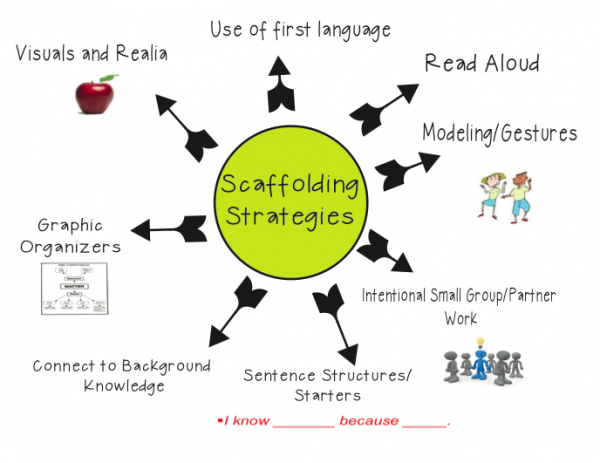
Scaffolding Techniques
I found this great article and graphic on scaffolding! They both encompass a variety of interesting scaffolding techniques that I want to use with my ELL student now and when I am an educator in the future. Check it out:
Journal #6
Journal #6
Today was a success! Carol attended today's tutoring session and was in a very happy mood. She had to continue to work on her PSA and had to work more on the design aspect of it. I decided to give her a simple tutorial about how to use the art features in Word. First, I showed her how to use the word art feature. Her face lit up when she realized how you are able to make a simple text look more appealing to the eye. It was a perfect, eye-catching addition to her PSA to have the name of the disorder in big and blue bubble letters.
Next, I showed her how to insert pictures into her PSA. This was very beneficial for her because she was never sure how to use it. She was very excited to learn how to use the clip art feature of Word because it is the best way to efficiently get a picture onto a Word document. Overall, her progress is outstanding with Word and she is able to navigate it much better than before.
I tagged this under Learners Growth and Development because I have seen a major improvement Carol's technology skills. She is able to use more features in Word than she ever has the capacity to do before. I want to continue to help her in this area by showing her the ins and outs of more applications like PowerPoint and even NearPod.
I tagged this under Learners Growth and Development because I have seen a major improvement Carol's technology skills. She is able to use more features in Word than she ever has the capacity to do before. I want to continue to help her in this area by showing her the ins and outs of more applications like PowerPoint and even NearPod.


Tuesday, March 8, 2016
Journal #5
Journal #5
Today was definitely a challenging day for me. I can't help but take it personally when some of the people in our tutoring group don't show up. It makes me wonder what I can do differently to make attendance higher. Maybe it would be smart to shorten tutoring to once a week for an hour because the tutees might be more motivated to show up.
Luckily, Carol ended up attending our tutoring session, but since no one else did, Emily, Megan and I had to tutor her. Carol said she was so grateful that she had three tutors because she loves the attention, which I thought was sweet.
Her assignment for the day was to do a PSA about a health-related topic. She pulled up an old document we had worked on about eating disorders and decided to choose the topic of Bulimia. She was very successful in finding relevant information about Bulimia for her PSA on Google, but was unable to add any sort of creativity to the PSA because she wasn't familiar with the design elements of Word. I wonder if, when I become a teacher, I should do a lesson on the different aspects of Word to compensate for those who do not have much knowledge on it.
I tagged this under Learners Growth and Development because she picked up new skills in Word regarding the design of her document. I want to continue to teach her more elements of Word that can improve the design of her document. For example, I can teach her how to do borders or even how to make pamphlets on Word.
Luckily, Carol ended up attending our tutoring session, but since no one else did, Emily, Megan and I had to tutor her. Carol said she was so grateful that she had three tutors because she loves the attention, which I thought was sweet.
Her assignment for the day was to do a PSA about a health-related topic. She pulled up an old document we had worked on about eating disorders and decided to choose the topic of Bulimia. She was very successful in finding relevant information about Bulimia for her PSA on Google, but was unable to add any sort of creativity to the PSA because she wasn't familiar with the design elements of Word. I wonder if, when I become a teacher, I should do a lesson on the different aspects of Word to compensate for those who do not have much knowledge on it.
I tagged this under Learners Growth and Development because she picked up new skills in Word regarding the design of her document. I want to continue to teach her more elements of Word that can improve the design of her document. For example, I can teach her how to do borders or even how to make pamphlets on Word.
You Are Not Alone

One of my ideas for fostering a positive community in my classroom is doing an activity called, "You Are Not Alone" where everyone in the class shares something they are going through, or have gone through. Chances are, someone else in the class has shared a similar experience or can understand what they are feeling. Thus, it will validate for them that they really aren't isolated because someone else is, or has been, in their shoes.
Tuesday, March 1, 2016
Developmental Matrix
Developmental Matrix
Age
|
Theorist
|
Categories
|
11-15/20
|
Piaget
Manning
Brighton and Stevenson
|
Cognitive/Language
- (Formal Operations) – Capable of thinking logically and abstractly, capable
of formulating hypotheses and testing them systematically; thinking is more
complex, and can think about thinking (metacognition)
Start to understand the nuances of metaphors, derive
meaning from traditional wisdom, and experience metacognition
Increasingly able to think through ideological topics,
argue a position, and challenge adult directives
|
Young Adolescents
10-11
12-15
|
Kellough & Kellough
Scales
Erikkson
|
Affective/Emotional
– Have a tendency to be moody, restless, and may exhibit erratic and
inconsistent behavior including anxiety, bravado, and fluctuations between
superiority and inferiority
Highly self-conscious and highly sensitive to criticism
of their perceived personal shortcomings
Industry vs. Inferiority when they identity themselves
by the tasks and skills they perform well
Identity vs. Identity when they explore and experiment
with various roles and experiences
|
Young Adolescents
|
Scales
Wiles et al.
Brighton
|
Social – Have
a strong need to belong to a group – with peer approval becoming more
important and adult approval decreasing in importance
May experiment with new behaviors as they seek social
position and personal identity
May experience conflicting loyalties to peer group and
family
Torn between their desire to conform to the peer group
norms and their aspiration to be distinctive and independent
|
Young Adolescents
|
Brighton
Scales
Kellough & Kellough and Scales
Kohlberg and Roney
|
Moral/Spiritual
– Many of the attitudes, beliefs, and values that young adolescents develop
remain with them for life
Move away from blanket acceptance of adult moral
judgment to the development of their own personal values; however, they
usually embrace the values of parents or key adults
Tend to be idealistic and possess a strong sense of
fairness
As they progress into the interpersonal conformity
stage, young adolescents begin to reconcile their understanding of people who
care about them with their egocentricity
|
I can relate to Jean Piaget’s
formal operational stage because when I was around the age of 11, I began to
think more abstractly. I remember my teachers always encouraging my love of
problem solving around this time. I would often use deductive reasoning by
drawing conclusions from abstract concepts using logic. I also remember my mom
getting frustrated with me because at this age, I would constantly ask, “What
ifs” to think more abstractly. She never had any concrete answers for me
because my questions were always pretty out there like, “What if the sun
doesn’t come up tomorrow?”
| Here is another interesting diagram by the theorist, Erik Erikson |
Subscribe to:
Posts (Atom)